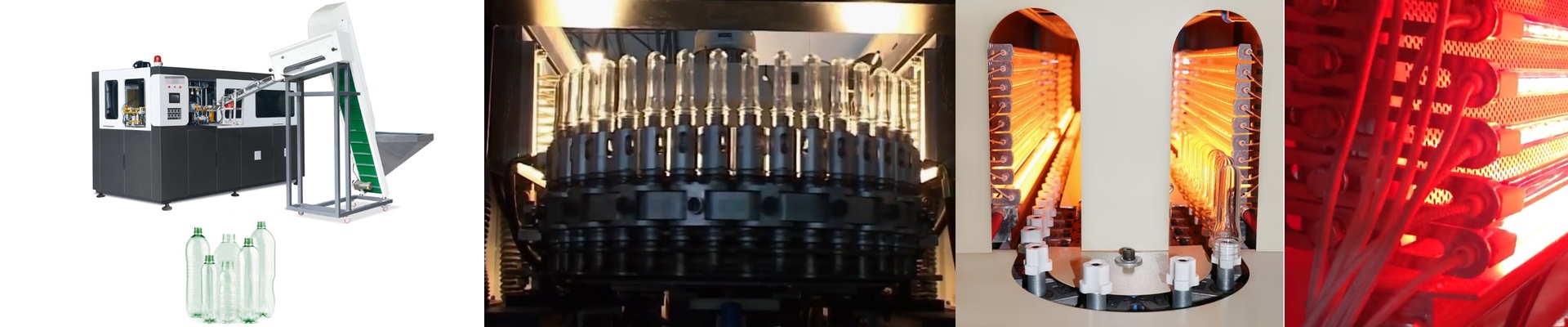
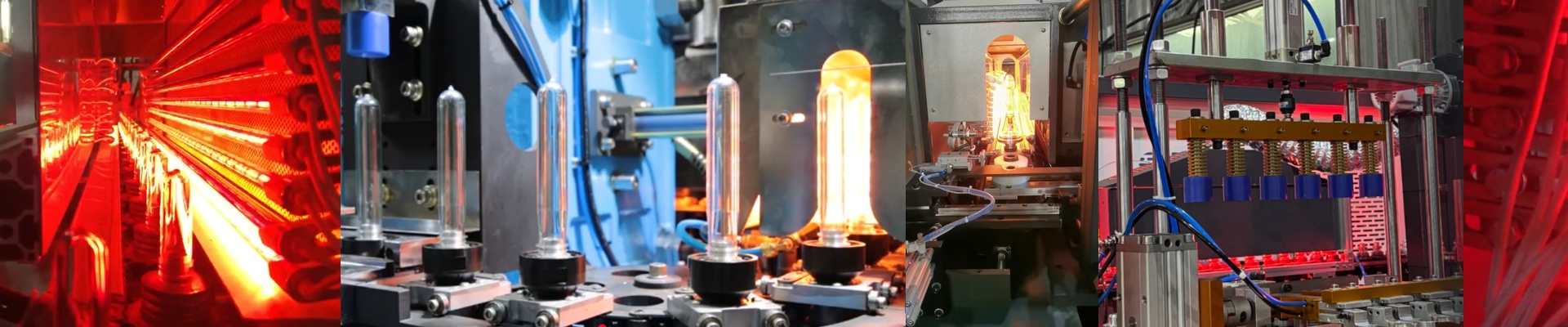

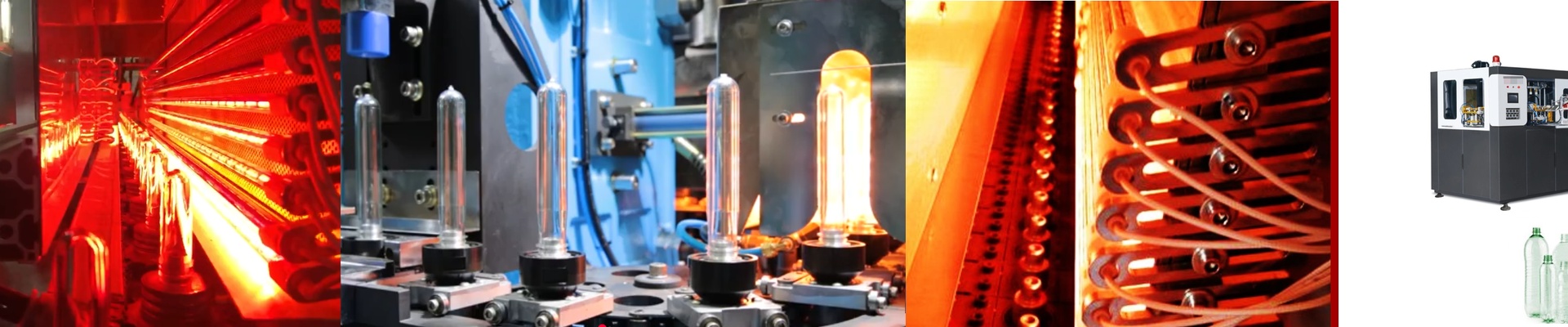
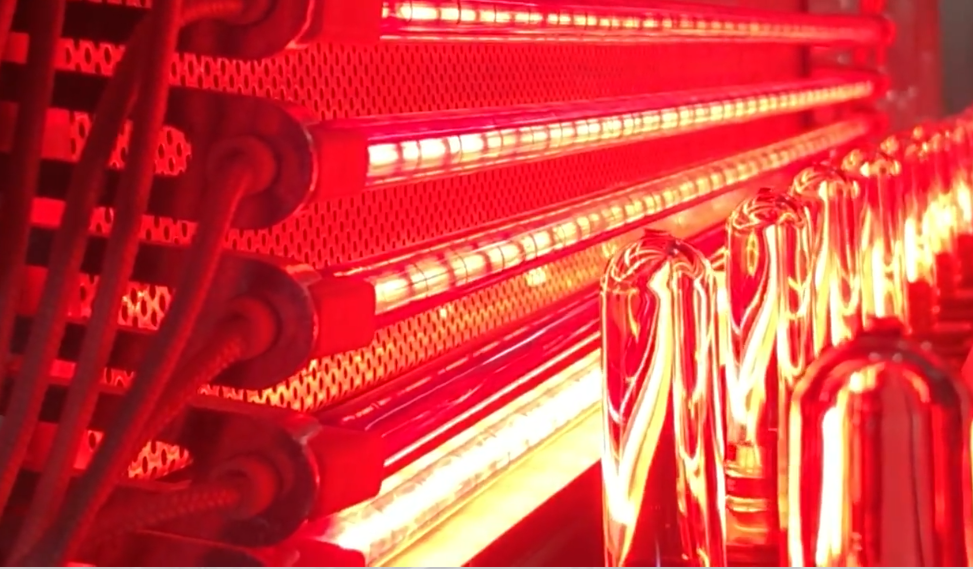
On the floor, the 5-gallon line doesn’t cut you any slack. Slow or uneven heating? You’ll see it immediately. You’re running heavy preforms, thick walls, and a long stretch path. When the heating tunnel can’t hold a stable, repeatable thermal profile, biaxial orientation goes sideways—weak shoulders, necks off-center, and scrap that climbs. Changeovers drag. Energy use creeps up. The heater that came with the machine was spec’d for smaller formats. It was never meant for the thermal mass of a 5-gallon preform. We built the 5-gallon large preform IR heater to swap guesswork for repeatable engineering. It’s a direct-fit infrared solution, designed for large-container stretch blow molding. The goal is controlled heating from the neck to the bottom dome, without hot spots or cold bands.
What matters, technically
The heart of this unit is short-wave infrared using quartz tube emitters. Short-wave IR penetrates the PET surface fast and heats volumetrically—exactly what you need with a thick, high-mass preform. Halogen filaments inside the quartz tube give you quick response, so the heater tracks setpoints without a long thermal lag. That means a repeatable heating curve, cycle after cycle. We match the thermal load to the blow molder’s heating tunnel requirements, in standard configurations that fit common OEM power envelopes. Emitter length and layout are chosen to cover the full preform height with uniform flux density, so the thermal field across the preform stays even. The payoff is predictable temperature distribution, which keeps stretch and blow behavior consistent. The build choices are plant-floor practical:
- Quartz tubes rated for rapid thermal cycling and sustained high temperature.
- Reflector geometry that focuses infrared energy onto the preform and keeps stray heat off the machine.
- R7s connector interfaces and standard mounting hardware, so the unit drops in with minimal rework.
- Built-in thermal protection to reduce over-temperature risk when something unexpected happens. What you’re really after are the numbers you can measure: stable temperature control, repeatable warm-up time, and consistent output across the whole heating zone. We design the heater to hit those targets with a defined warm-up time to operating temperature, and we size the power to maintain setpoint under full production load—not just when the machine is idling.
Why this approach works on 5-gallon
Large preforms are a different animal. Thermal mass is higher, wall thickness varies, and the stretch ratio is bigger. Convective heaters struggle to get the interior up to temperature without scorching the surface, which kills melt strength right when you need it most. Done right, infrared heats more uniformly, and short-wave energy penetrates and reduces the temperature gradient across the wall. You feel the difference in three places. First, right in the heating tunnel. The thermal profile settles in. We set the temperature curve—ramp and dwell—so the preform lands in the correct process window across the entire body. That gives you the right temperature distribution for stretch blow molding, without overheating the neck ring or the bottom. Second, at the blow station. With even heating, material distribution behaves predictably. Shoulder strength improves, sidewall clarity is consistent, and the bottom dome forms with the right energy absorption. Rejects from uneven stretch and weak weld lines drop off. Third, on the energy side. Infrared is directional. You aim the energy where it needs to go—onto the preform—instead of dumping heat into the air and the machine frame. In practice, recovery to setpoint is faster after door cycles, and steady-state draw is lower. That shows up as fewer kWh per thousand bottles. This heater is engineered for the realities of 5-gallon formats on blow molders from Sidel, Krones, SIPA, Husky, SACMI, and Nissei ASB. We size power, length, and emitter layout to match the OEM’s heating zone geometry, so you get 1:1 compatibility and an installation you can plan.
The practical details
Installation is straightforward on most machines, but the details matter. The heater has to align with the preform path and sit within the reflector cavity as designed. Misalignment creates uneven heating and shows up as hot spots on the preform. Use the supplied mounting brackets and verify gap tolerances to the reflector. If the machine has variable zone control, confirm the heater’s power curve is compatible with the controller’s output stage to avoid current spikes. Infrared is line-of-sight. Keep the emitter and reflector surfaces clean. Dust and film buildup scatter energy and cut effective output. In environments with airborne particulate or high humidity, schedule a quick cleaning cycle and inspect reflectors during changeovers. One trade-off to keep in mind: infrared responds fast, but it also cools fast when something blocks it or it’s out of focus. If you run frequent format changes, make sure the heater is re-shimmed and re-focused as part of the changeover checklist. That five-minute adjustment keeps the thermal field consistent across preform lengths. If your plant runs 5-gallon preforms on a blow molder that was never optimized for their thermal mass, the bottleneck is usually the heater. Swap in a unit built for the job, match the power, tune the thermal field, and the line runs smoother. Scrap drops. The energy meter starts moving in your favor. We build the 5-gallon large preform IR heater to do exactly that—day in, day out. If you’re chasing stable heating on heavy preforms, start by matching the infrared output to the preform, not the other way around.